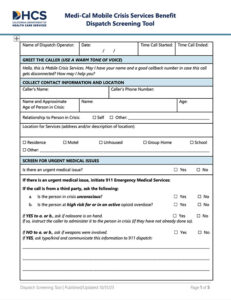
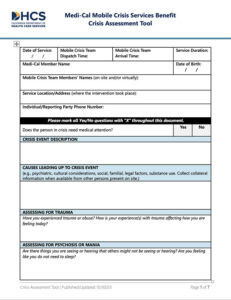
In partnership with the Department of Health Care Services (DHCS), M-TAC is pleased to offer three tools for use by county mobile crisis teams. Click here to access the Crisis Assessment Tool, Dispatch and Triage Tool, and Safety Planning Tool. Per Behavioral Health Information Notice 23-025, counties are required to use standardized tools as part of their dispatch and triage, assessment, and safety planning protocols.
All counties are required to use the tools that they indicated in their submitted and approved Implementation Plans.
Counties may adapt these tools as needed to best serve their specific cultural and linguistic communities. However, these tools must be used as a baseline: counties must ask these questions as part of the dispatch, assessment, and safety planning processes. These questions serve as a minimum requirement; counties may add questions to these tools at their discretion.
Each tool is accompanied by a Companion Prompt Guide. These guides provide alternative language to that used in the tools and can be used to elicit the required information in slightly different ways. These potential prompts have been developed to reflect some of the cultural and linguistic preferences of California’s diverse communities. Counties should assume that mobile crisis team members will adapt their approach to asking required questions to meet the specific needs of each county’s residents.
M-TAC offered two trainings for the crisis assessment tool and dispatch tool. Each training includes a detailed walkthrough of the tools, recommended strategies for using the tool, and an opportunity to ask questions about the tool and its implementation. Please reference the crisis safety planning training, which provides strategies and best practices for effective, culturally responsive, and trauma-informed safety planning.
Additional trainings on how to utilize the standardized tools can be found on our LMS under the “Triage and Appropriate Dispatch of Mobile Crisis Teams” recommended training recording and the “Crisis Assessment” required training module.
The Medi-CAL Mobile Crisis (M-TAC) Training and Technical Assistance Center can provide coaching, consultation, and other TA supports to individual counties. Please click here to request TA.
All Tool and Guide Links:
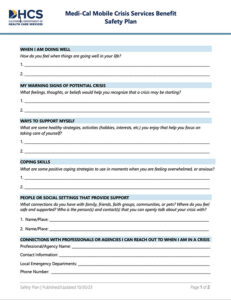
The Safety Planning Tool has been translated into all 18 threshold languages in California, including: Arabic, Armenian, Cambodian/Khmer, Chinese, Farsi, Hindi, Hmong, Japanese, Korean, Laotian, Mien, Punjabi, Russian, Spanish, Tagalog, Thai, Ukrainian, and Vietnamese.