

Medi-Cal Mobile Crisis Training and Technical Assistance Center (M-TAC)
Welcome! The Medi-Cal Mobile Crisis Training and Technical Assistance Center (M-TAC) is a DHCS-funded project, led by the Center for Applied Research Solutions (CARS), in collaboration with Advocates for Human Potential, Inc. (AHP). M-TAC is dedicated to supporting California counties in implementing the Medi-Cal Mobile Crisis Services Benefit. M-TAC provides training, resources, and ongoing coaching and consultation to counties and their mobile crisis teams.
Mobile crisis services are a community-based intervention designed to provide de-escalation and relief to individuals experiencing a behavioral health crisis wherever they are, including at home, work, school, or in the community. Mobile crisis services are provided by a multidisciplinary team of trained behavioral health professionals in the least restrictive setting. Mobile crisis services include screening, assessment, stabilization, de-escalation, follow-up, and coordination with healthcare services and other supports. Mobile crisis services are intended to provide community-based crisis resolution and reduce unnecessary law enforcement involvement and emergency department utilization. The mobile crisis services benefit will ensure that Medi-Cal beneficiaries have access to coordinated crisis care 24 hours a day, 7 days a week, 365 days per year.
Required Core Trainings
M-TAC is currently developing the core module trainings required for all mobile crisis response providers. Check back for upcoming trainings on crisis assessment, trauma-informed care, crisis intervention/de-escalation, harm reduction, and safety planning.
Required Enhanced Trainings
DHCS identified additional required enhanced trainings that will cover crisis response strategies for special populations (Children, Youth, and Families; Tribal Communities; and Individuals with Intellectual and Development Disabilities).
Recommended Supplemental Trainings
While not required, these trainings are highly recommended and are being offered to support the development of specialized competencies in mobile crisis response.

New! Learning Management System (LMS)
This LMS will be your central hub for accessing Medi-Cal Mobile Crisis Training and Technical Assistance Center (M-TAC) trainings, earning continuing education hours (CEHs) and certificates of completion (CoCs), and engaging in interactive learning experiences.
The trainings available on the M-TAC LMS are developed for California counties and mobile crisis teams to support the implementation of the Medi-Cal Mobile Crisis Services Benefit.

New! Introducing Evoke™ – Designed to support your workplace resilience and well-being
As part of the Medi-Cal Mobile Crisis Training and Technical Assistance Center (M-TAC), the Department of Health Care Services (DHCS) has approved Advocates for Human Potential, Inc. (AHP) to offer free access to Evoke™ to all staff who work on the crisis care continuum.
Work-related stress and burnout are real challenges, and Evoke is a tool designed to help. With a range of engaging activities, Evoke has been tested and proven as an effective tool for stress reduction.

New! First Episode Psychosis Trainings and Resources
Visit M-TAC’s First Episode Psychosis (FEP) page to access a collection of trainings and tools designed to help mobile crisis teams effectively recognize and respond to individuals experiencing psychosis. This page serves as a hub for behavioral health professionals seeking evidence-informed guidance on crisis intervention, early identification, and coordinated follow-up care.
FEP refers to the first occurrence of symptoms—such as hallucinations or delusions—that can be confusing and distressing, most often affecting youth and young adults. Because early intervention can greatly improve recovery, mobile crisis teams play a vital role in providing immediate, culturally responsive care and connecting individuals to ongoing treatment.
This resource hub features a four-part recorded training series and accompanying materials, including a visual learning tool and summary. Both components offer practical tips, strategies, and cultural considerations for mobile crisis teams. The page also features an interactive California FEP map and other practical materials to strengthen crisis response and care coordination.
Building Cultural Responsiveness in Mobile Crisis Teams: Five-part Training Series
This five-part training series features specialists and leading organizations sharing current research, lived experience, and practical strategies to strengthen culturally responsive mobile crisis care throughout California.
Informed by M-TAC’s Year 1 training on cultural humility, the series focuses on serving specific populations, including Asian American and Pacific Islander, Black and African American, Latin and Latinx, LGBTQIA+, youth, and young adults.
Each recording highlights best-practice approaches to crisis intervention while addressing the social, cultural, and economic factors that shape behavioral health access and engagement. Participants will gain insights into implicit bias, culturally informed de-escalation strategies, and community-specific resources to more effectively connect individuals in crisis with appropriate care.
By centering cultural humility, this training series supports mobile crisis providers, county partners, and behavioral health leaders in improving outcomes for diverse populations and ensuring safe, equitable, and inclusive care.
Use the links below to watch any of the five trainings in this series.
New! Mobile Crisis Tools for Tribal Providers and Community Partners
This page features four new resources specifically crafted to enhance mobile crisis services in Tribal and Urban Indian communities. These tools are designed to honor and reflect the rich histories and cultural contexts of these communities while promoting core values such as cultural humility and local knowledge.
These resources offer practical frameworks for implementing a Tribal-based mobile crisis team and, more broadly, establishing 988 crisis services and mobile crisis responders. They support efforts to assess community readiness, facilitate smooth transitions in care, and engage with Tribal leadership respectfully and collaboratively.
Through the integration of culturally grounded approaches, these tools empower both responders and community leaders to develop and sustain effective crisis response programs that prioritize safety, trust, and overall well-being across California.
Customer Satisfaction Survey Sample Template
This sample survey template is a tool that county mobile crisis teams can use to collect data about service recipients’ experience with their care. Per Behavioral Health Information Notice (BHIN) 23-025, all counties are required to collect consumer satisfaction data. This document provides a recommended set of survey questions counties can use in meeting this requirement, and also briefly describes some best practices in data collection. It is up to each county to develop their own process that best fits their programs.
Medi-Cal Mobile Crisis Marketing and Outreach Strategies
M-TAC is pleased to share the Medi-Cal Mobile Crisis Marketing and Outreach Strategies document. M-TAC and DHCS developed these strategies for use by mobile crisis teams to ensure your community is aware of the new Medi-Cal benefit. This includes tips on language and communication styles, building partnerships and collaborations, and how to use data to drive outreach.
In addition to the strategies document, DHCS has created an accompanying DHCS Mobile Crisis Flyer that counties can use to support their marketing and outreach efforts within their communities.
Translated Standardized Safety Planning Tool
In partnership with the Department of Health Care Services (DHCS), M-TAC is pleased to share that the Safety Planning Tool has been translated into all 18 threshold languages in California, including: Arabic, Armenian, Cambodian/Khmer, Chinese, Farsi, Hindi, Hmong, Japanese, Korean, Laotian, Mien, Punjabi, Russian, Spanish, Tagalog, Thai, Ukrainian, and Vietnamese.
As a reminder, M-TAC and DHCS developed a standardized crisis safety planning template available for use by mobile crisis teams operating under the new Medi-Cal benefit. All mobile crisis teams implementing the Medi-Cal Mobile Crisis Services benefit will, when appropriate, engage in crisis safety planning with members who receive a mobile crisis response. Use the link below to access the new translated tools. Choose the language(s) that meet your local community’s needs from the drop-down menu on the latest safety planning tool webpage.
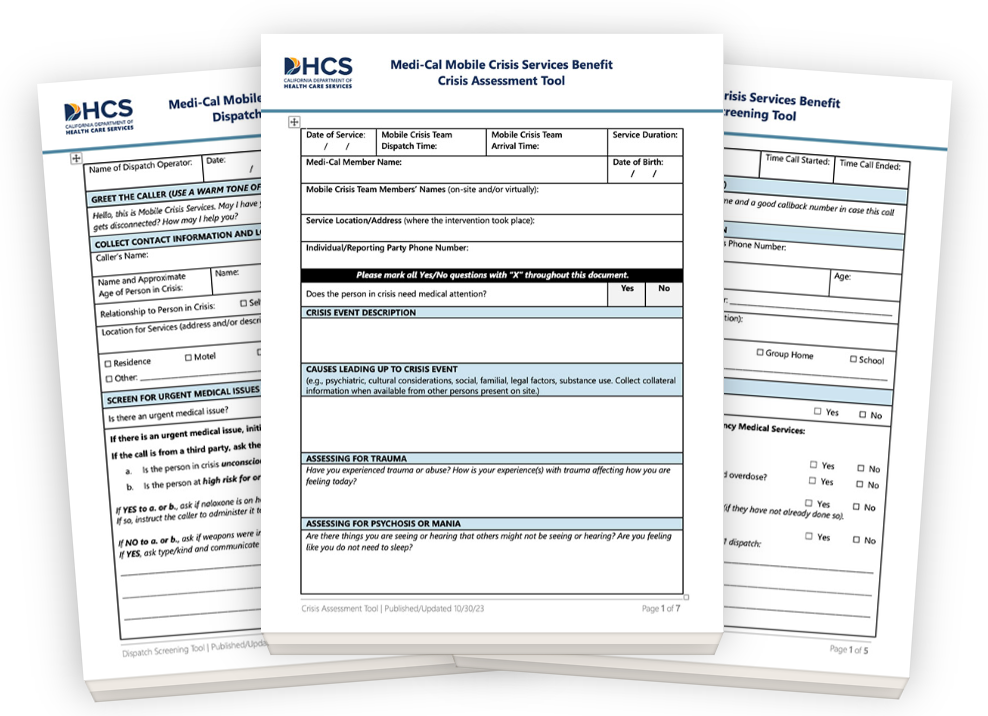
Standardized Tools
In partnership with the Department of Health Care Services (DHCS), M-TAC is pleased to offer the Crisis Assessment, Dispatch and Triage, and Safety Planning standardized tools for use by county mobile crisis teams. Per Behavioral Health Information Notice 23-025, counties are required to use standardized tools as part of their dispatch and triage, assessment, and safety planning protocols. Counties can use either these tools or tools of their own creation that have been approved in writing by DHCS.
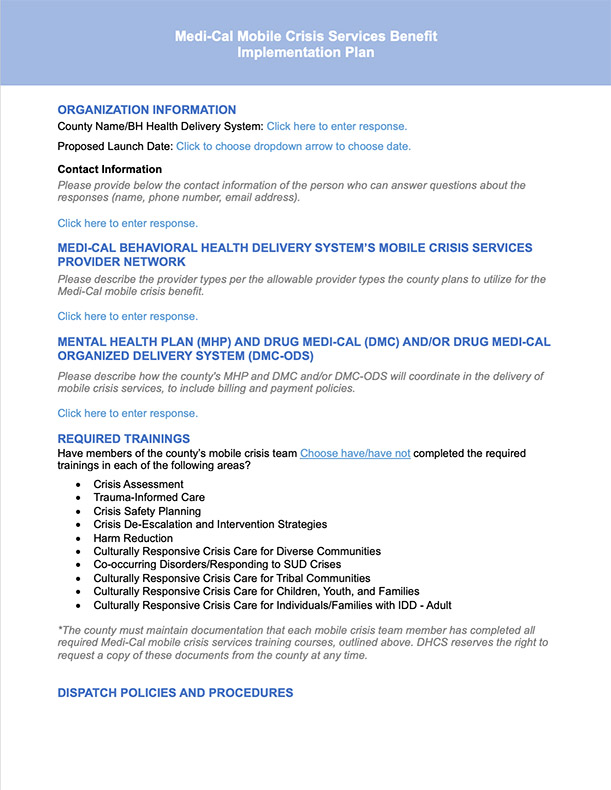
Implementation Plan
Please find the Implementation Plan (IP) template, as described in Section VIII(c) of BHIN 23-025. Counties must complete an IP and receive written approval from DHCS.

24/7 Crisis Service Hotline Numbers for California Counties
In partnership with County Behavioral Health Departments and the Department of Health Care Services (DHCS), M-TAC is pleased to offer the directory for 24/7 Crisis Service Hotline Numbers for California Counties. Some counties may still be ramping up and their 24/7 hotline number is coming soon!
New Archived Trainings Available
Culturally Responsive Crisis Care for Children, Youth, and Families
May 27, 2025
RECOMMENDED SUPPLEMENTAL TRAINING
Focusing on children, youth, and families, this training video equips mobile crisis responders with essential tools and strategies for supporting young people and their caregivers during mental health crises. Drawing on deep community experience and subject matter expertise, the session recording emphasizes family systems, culturally responsive communication, and family-centered approaches to care.
Culturally Responsive Crisis Care in Latino/a Communities
May 15, 2025
RECOMMENDED SUPPLEMENTAL TRAINING
Training 4 focuses on Latin and Latinx populations and aims to equip mobile crisis team members with historical context, cultural insight, and practical skills to provide compassionate, culturally responsive crisis care. Understanding population-level challenges in behavioral health access and outcomes is key to building trust and improving service delivery.
Practical Application of FEP Intervention Strategies: Mobile Crisis Team Integration
April 29, 2025
RECOMMENDED SUPPLEMENTAL TRAINING
This fourth session focused on applying the practical skills necessary for effective mobile crisis intervention, building on foundational skills in recognizing and responding to FEP related crises developed during the previous sessions of the program.
Culturally Responsive Crisis Care in Black and African American Communities
April 15, 2025
RECOMMENDED SUPPLEMENTAL TRAINING
Training three focused on the Black/African American population and aimed to equip mobile crisis team members with the historical knowledge, cultural awareness, and practical skills needed to provide compassionate, culturally responsive crisis care to Black and African American communities.
Follow-up Check-Ins: Connection to Ongoing Services and Coordinated Specialty Care (CSC)
March 18, 2025
RECOMMENDED SUPPLEMENTAL TRAINING
Training two in this series focuses on the LGBTQIA+ population and aims to equip mobile crisis service providers with best-practice strategies for crisis intervention and culturally responsive services for this community. By emphasizing social and clinical factors that influence behavioral health access, we aim to foster connections between individuals in crisis and culturally accessible services.
Culturally Responsive Crisis Care in LGBTQIA+ Communities
March 13, 2025
RECOMMENDED SUPPLEMENTAL TRAINING
Training two in this series focuses on the LGBTQIA+ population and aims to equip mobile crisis service providers with best-practice strategies for crisis intervention and culturally responsive services for this community. By emphasizing social and clinical factors that influence behavioral health access, we aim to foster connections between individuals in crisis and culturally accessible services.
FEP and Mobile Crisis Assessment and Intervention Strategies
February 25, 2025
RECOMMENDED SUPPLEMENTAL TRAINING
This second webinar will equip mobile crisis teams with trauma-informed crisis intervention strategies to support identification, crisis assessment techniques, best practices for interventions and safety planning, and culturally appropriate interactions and communication with individuals and their families experiencing first episode psychosis.
February Community of Practice
February 1, 2024
RECOMMENDED SUPPLEMENTAL TRAINING
The February CoP focused on coordination with outside delivery systems. The CoP also featured guest speaker, MK Youngblood, who provided an introduction on best practices for outreaching and collaborating with tribes on providing mobile crisis services.
Behavioral Health Information Notice
No. 23-025
This document provides guidance regarding implementation of the Medi-Cal Community-Based Mobile Crisis Intervention Services benefit by county mental health plans (MHPs), Drug Medi-Cal (DMC) counties and Drug Medi-Cal Organized Delivery System (DMC-ODS) counties.
Featured Resource
The National Guidelines for Child and Youth Behavioral Health Crisis Care offers best practices, implementation strategies, and practical guidance for the design and development of services that meet the needs of children, youth, and their families experiencing a behavioral health crisis. Additional technical guidance is provided in a companion report produced by SAMHSA in conjunction with the National Association of State Mental Health Program Directors, A Safe Place to Be: Crisis Stabilization Services and Other Supports for Children and Youth.